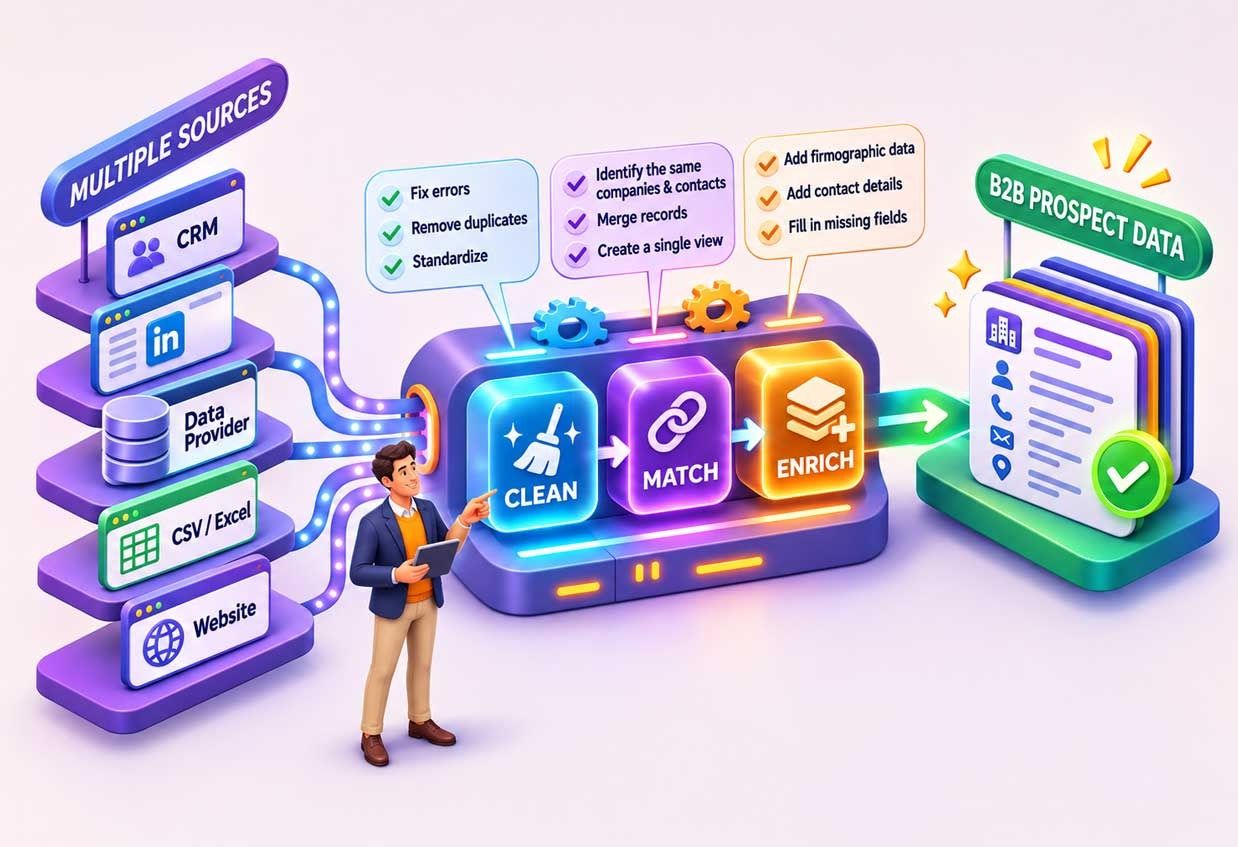
Quick answer: How do you clean, match and enrich B2B prospect data from multiple sources?
Bring every source into one pipeline that does four jobs in order: normalise each record into a consistent shape, match the records that describe the same company or person, enrich the merged record with firmographic and role data, then score it. Record where every field came from and when it was last checked, so people can trust the result and trace any value back to its source.
Why does B2B prospect data end up in such a mess?
Because it comes from places that were never designed to agree. A typical demand-generation or sales team pulls prospect data from:
- its own CRM and campaign history
- third-party data providers and intent feeds
- bought or acquired lists
- event registrations, content downloads and spreadsheets kept by individual reps
Each source spells company names its own way, uses its own job-title conventions and goes out of date at its own rate. The result is familiar: the same company appears three times under three names, contacts carry titles that don’t map to any seniority, and someone reconciles it all by hand before every campaign.
That manual step is the real cost. It’s slow, it depends on the one or two people who know the quirks, and it has to be repeated every time.
What are the stages of a prospect data pipeline?
There are four, and the order matters. Enrich before you match and you pay to enrich duplicates. Score before you enrich and you score the gaps.
Stage | What it does | What goes wrong if you skip it |
|---|---|---|
1. Normalise | Lands every source in one schema: consistent field names, country and phone formats, cleaned company names and domains | Matching fails on trivial differences, such as “Ltd” and “Limited” |
2. Match and merge | Finds records that describe the same company or person and merges them into one profile | Duplicates inflate counts, split engagement history and get contacted twice |
3. Enrich | Fills the gaps: industry, size, location, job function and seniority | Segments and scores are built on missing fields |
4. Score | Ranks accounts and contacts on agreed signals | Teams chase whoever is loudest, not the best fit |
Running all four as a scheduled, repeatable pipeline, rather than a scramble before each campaign, is what turns a cleanup into a data product.
How do you match the same company across different sources?
Use the strongest identifier you have first, fall back to weaker evidence, and keep a confidence level on every match.
- Registered identifiers. In the UK, a Companies House number is the most reliable key when a source carries one.
- Website domain. Usually the next best key, once you strip “www”, paths and tracking parameters. Treat free email domains such as gmail.com as no evidence at all.
- Normalised name plus location. Lower-case the name, remove punctuation and legal suffixes (Ltd, Limited, plc, LLP, GmbH), then compare names within the same country or postcode area.
- Fuzzy similarity. String-similarity scores catch typos and word-order changes (“Smith & Sons Engineering” and “Smith and Sons Eng”), but only as supporting evidence.
Two practical choices decide whether this works at scale. First, block before you compare: only compare records that share something cheap to check, such as country or the start of the domain, or the number of comparisons explodes. Second, set two thresholds. Above the upper one, merge automatically. Between the two, send the pair to a short human review queue. Below the lower one, leave them apart. Wrongly merging two companies does more damage than leaving a duplicate.
When records merge, decide field by field which source wins. A common rule set: the CRM wins for relationship fields such as owner and stage, the most recently verified source wins for job title, and a registered source wins for legal name and address. Keep every original value and its source, so a bad merge can be undone. This is the core of our data engineering work, and it’s where most of the effort goes.
What should enrichment add, and where does AI help?
Enrichment should fill the fields your segments and scores depend on, and nothing you won’t use. For most B2B teams that means industry, employee band, location, job function and seniority.
AI earns its place on narrow, checkable jobs:
- Classifying job titles into a consistent function and seniority, so “Head of HSSE”, “QHSE Lead” and “EHS Manager” land in one function at the right levels.
- Filling gaps in firmographic fields from evidence already held, with a confidence score attached.
- Turning documents into data: reading a PDF, web page or video and producing a category, summary and language, so content and contacts can be linked.
- Suggesting matches for the review queue, rather than making the final call on borderline pairs.
Label every AI-filled field as inferred and keep the value it replaced, so people can see what the system guessed and correct it. More on how we approach this in our AI systems work.
How do you keep prospect data accurate after the cleanup?
Treat accuracy as something the pipeline checks continuously, not a one-off project.
- Record freshness per field. Store when each value was last verified, and by which source.
- Re-run the pipeline on a schedule and before major campaigns, not only when someone complains.
- Watch for anomalies. A source that suddenly sends half as many records, or a jump in unmatched companies, usually means something upstream changed.
- Keep lineage. Every merged record should show which sources it came from, so “where did this come from?” takes seconds to answer.
- Honour suppressions everywhere. An opt-out recorded in one system has to reach all of them.
Accuracy is also a legal point. Under UK GDPR, personal data must be accurate and kept up to date, and B2B marketing to named individuals still needs a lawful basis and must respect opt-outs. The ICO’s direct marketing guidance sets out the rules for each channel.
What did this look like for Rethink Demand?
For Rethink Demand, a B2B marketing business, we designed and built Hermes, a prospect intelligence platform. Their prospect data came from internal systems, third-party providers and acquired lists, and the same company would appear several times under slightly different names. Every campaign started with someone reconciling it by hand.
Hermes follows the four stages above:
- ingestion pipelines that land data from any source in one validated shape
- a bespoke matching engine that finds the same company behind different names and merges the records into one profile
- automated enrichment and account scoring, including filling missing job functions, seniority and firmographic gaps
- orchestration with job scheduling, freshness checks, anomaly detection and traceability at each stage
It’s built on Microsoft Azure, Python, Azure, Clickhouse, and React. Version 1 went live in 2023, version 2 shipped in 2024, and it now runs Rethink Demand’s audience intelligence work day to day. The full write-up is in the Hermes case study.
Frequently asked questions
What’s the difference between data cleansing and data enrichment?
Cleansing fixes what you already hold: formats, spelling, duplicates and invalid values. Enrichment adds what you don’t hold, such as industry, company size or seniority. Cleanse and match first, so you only enrich each company once.
How do you deduplicate companies with different names?
Match on the strongest identifier available (a registered company number, then the website domain), then on a normalised name within the same location. Merge automatically only above a high confidence threshold, and send borderline pairs to a person.
How often should B2B prospect data be refreshed?
Often enough that nothing goes into a campaign unchecked. Run the pipeline on a schedule, re-verify before major campaigns, and record when each field was last checked so stale values are visible.
Can AI clean B2B prospect data on its own?
Not reliably. AI is good at classifying job titles, filling gaps from existing evidence and suggesting matches. Merges, suppressions and scoring rules still need clear thresholds, labels on inferred values and a person reviewing the borderline cases.
Do we need to replace our CRM?
Usually not. The pipeline sits alongside it, reads from it and writes clean, merged records back, so the CRM stays the place your team works.
Talk through your prospect data
If your team reconciles lists by hand before every campaign, a free 30-minute working session with one of our senior engineers is a quick way to see what a matching and enrichment pipeline would look like for your sources. Book a call, or read how we built Hermes for Rethink Demand.