Week 3 of the High Digital Workflow Automation Series.
Quick answer: What’s the difference between agentic AI, RPA and workflow automation?
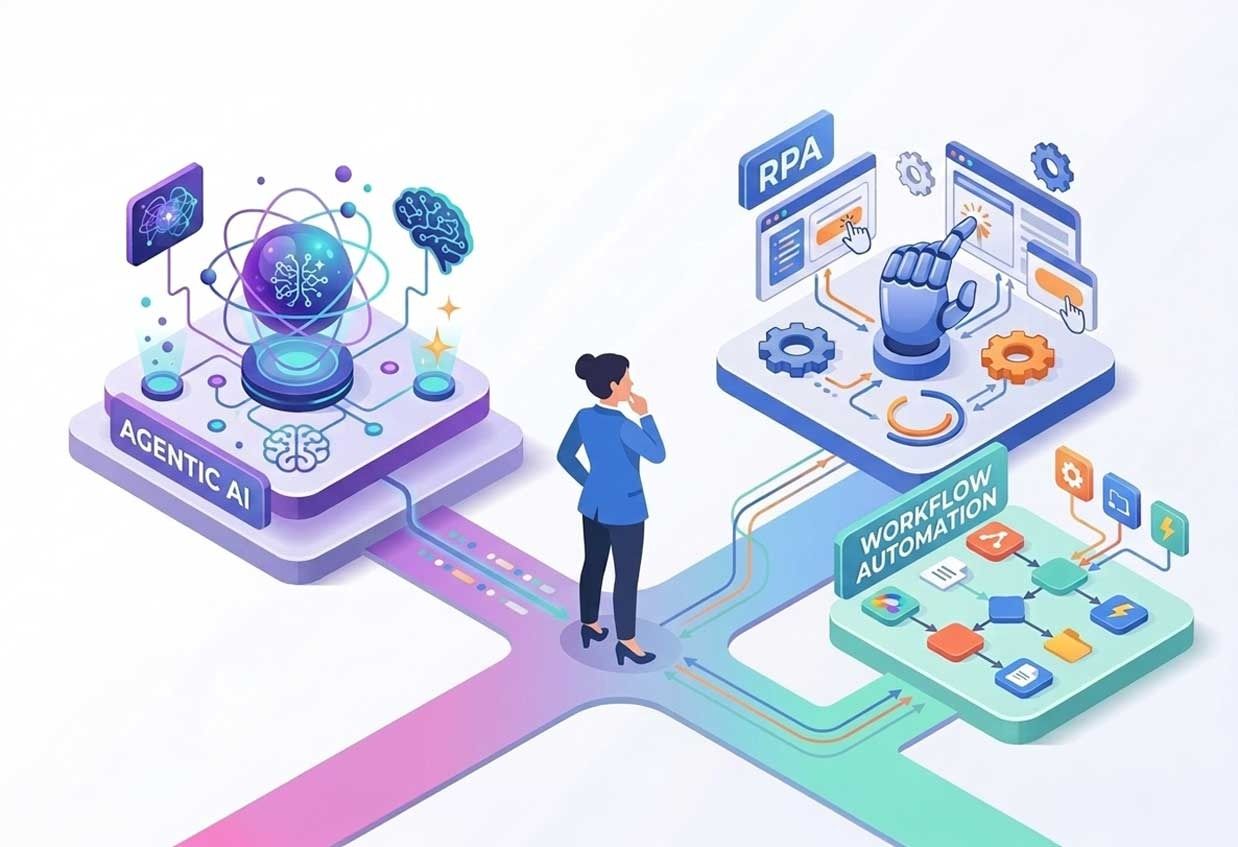
- Workflow automation connects systems through APIs using fixed rules. It is best for predictable processes with structured data.
- RPA (robotic process automation) mimics a person clicking through screens. It is best when a system has no API.
- Agentic AI uses a large language model to interpret unstructured input and decide what to do next. It is best for variable work that needs judgement.
Most real business processes need a combination of all three.
Key takeaways
- Use the simplest tool that reliably does the job. Rules beat AI wherever the path is predictable.
- RPA is a workaround for missing APIs, not a long-term architecture.
- AI agents earn their cost on unstructured, variable work: emails, documents, exceptions.
- The strongest designs pair AI judgement with deterministic workflows and human approval for high-risk steps.
What is workflow automation?
Workflow automation moves data between systems when something happens. A form is submitted, a record is created in the CRM, and a notification goes to Slack. Each step is defined in advance and connects through an API.
- Strengths: fast, cheap to run, predictable and easy to audit.
- Limits: breaks when inputs are messy or when the process needs a decision the rules didn’t anticipate.
- Typical tools: Zapier, Make, n8n, Power Automate cloud flows and custom integration services.
What is RPA?
RPA software operates an application’s user interface the way a person would, by reading screens, clicking buttons and typing into fields. It exists for systems that can’t be integrated any other way, such as legacy desktop applications, supplier portals and green-screen terminals.
- Strengths: automates systems with no API, without changing those systems.
- Limits: brittle, because a changed button label or page layout can break a bot. It is also slower than an API call and needs ongoing maintenance.
- Typical tools: Power Automate desktop flows and dedicated RPA platforms such as UiPath.
What is agentic AI?
An AI agent is given a goal, a set of tools and some context. It then decides which steps to take. It can read an email and work out what the sender wants, extract fields from an invoice in any layout, look up records and choose the next action, and ask a human when it’s unsure.
- Strengths: handles unstructured input and variation that would need hundreds of rules.
- Limits: non-deterministic, costs more per run, and needs guardrails, testing and monitoring to be trusted.
- Typical tools: Copilot Studio, the AI nodes in n8n and similar platforms, and custom agents built on model APIs with tool calling and MCP.
How do they compare?
- Input: workflow automation needs structured data. RPA needs structured screens. Agentic AI can handle emails, documents, chat and images.
- Decision-making: workflow automation follows fixed rules and RPA follows fixed steps. Agentic AI reasons within limits you set.
- Integration method: workflow automation uses APIs. RPA uses the user interface. Agentic AI uses tools, which are usually APIs and can include RPA bots.
- Reliability: workflow automation is the most reliable, and agentic AI the least without guardrails. RPA is only as reliable as the screens it depends on.
- Cost per run: workflow automation is the cheapest, and agentic AI the most expensive because of model usage.
- Maintenance: workflow automation is low-maintenance, RPA high, and agentic AI medium, since it needs ongoing evaluation and prompt updates.
How do you choose the right approach?
Ask four questions about each step of the process, rather than about the process as a whole:
- Is the input structured? If yes, use workflow automation. If it’s free text, documents or images, consider an AI agent.
- Does the target system have an API? If yes, integrate through the API. If not, consider RPA, or ask whether the system should be replaced.
- Is the path predictable? If the same inputs always lead to the same actions, use rules. If the step needs judgement, use an agent.
- What does an error cost? If a mistake is expensive or regulated, such as payments, contracts or personal data, add human approval, whatever the technology.
What does a combined process look like?
Take accounts payable, where suppliers email invoices in dozens of formats:
- An AI agent reads the email. It extracts the supplier, amount, PO number and line items, and flags anything unusual.
- Workflow automation matches the invoice against the purchase order in the ERP through its API, then routes it for approval based on value.
- RPA uploads remittance details to a supplier portal that has no API.
- A person approves exceptions, such as mismatched amounts, new suppliers or invoices above a threshold, from a simple queue.
Each technology does what it’s best at. The agent handles variation, the workflow handles the rules, RPA covers the legacy gap, and people handle risk.
What are the most common mistakes?
- Using an AI agent for a deterministic task. If a rule can do it, a rule is cheaper, faster and auditable.
- Treating RPA as permanent. Every screen-scraping bot is technical debt. Plan to replace it with an API integration where you can.
- Giving agents too much access. Agents should have least-privilege tools, spending or action limits, and full logging.
- Skipping evaluation. Test agents against real historical cases before going live, and keep monitoring accuracy afterwards.
- Automating a broken process. Automation makes a bad process run faster. Fix the process first.
How High Digital can help
We map processes step by step, choose the right mix of workflow automation, RPA and agentic AI, and build the parts that off-the-shelf tools can’t handle as custom software. If you’re not sure where AI fits in a process, scope your project and we’ll help you find out.
Next week (Week 4): Self-Hosting n8n or Activepieces in Production: A Security & GDPR Checklist.
Frequently asked questions
Is agentic AI replacing RPA?
Not entirely. AI agents are taking over work that RPA handled badly, such as reading documents and handling exceptions. RPA is still useful for operating legacy systems with no API, and agents can call RPA bots as tools.
Is Power Automate RPA or workflow automation?
Both. Cloud flows provide API-based workflow automation, desktop flows provide RPA, and Copilot Studio adds AI agents on top.
What is human-in-the-loop automation?
It is a design where automation pauses for a person to review or approve a step before continuing. It is typically used for high-value, high-risk or low-confidence decisions.
Which type of automation is cheapest to maintain?
API-based workflow automation. RPA needs the most maintenance because interface changes break bots. AI agents need regular evaluation and prompt updates.
When should a business use agentic AI?
When a process involves unstructured input or variable decisions, and the volume justifies the build and running costs. Invoice processing, support triage, document review and lead qualification are common examples.