Last updated: 16 November 2026
Quick answer: How do you decide which AI prototypes should become real products?
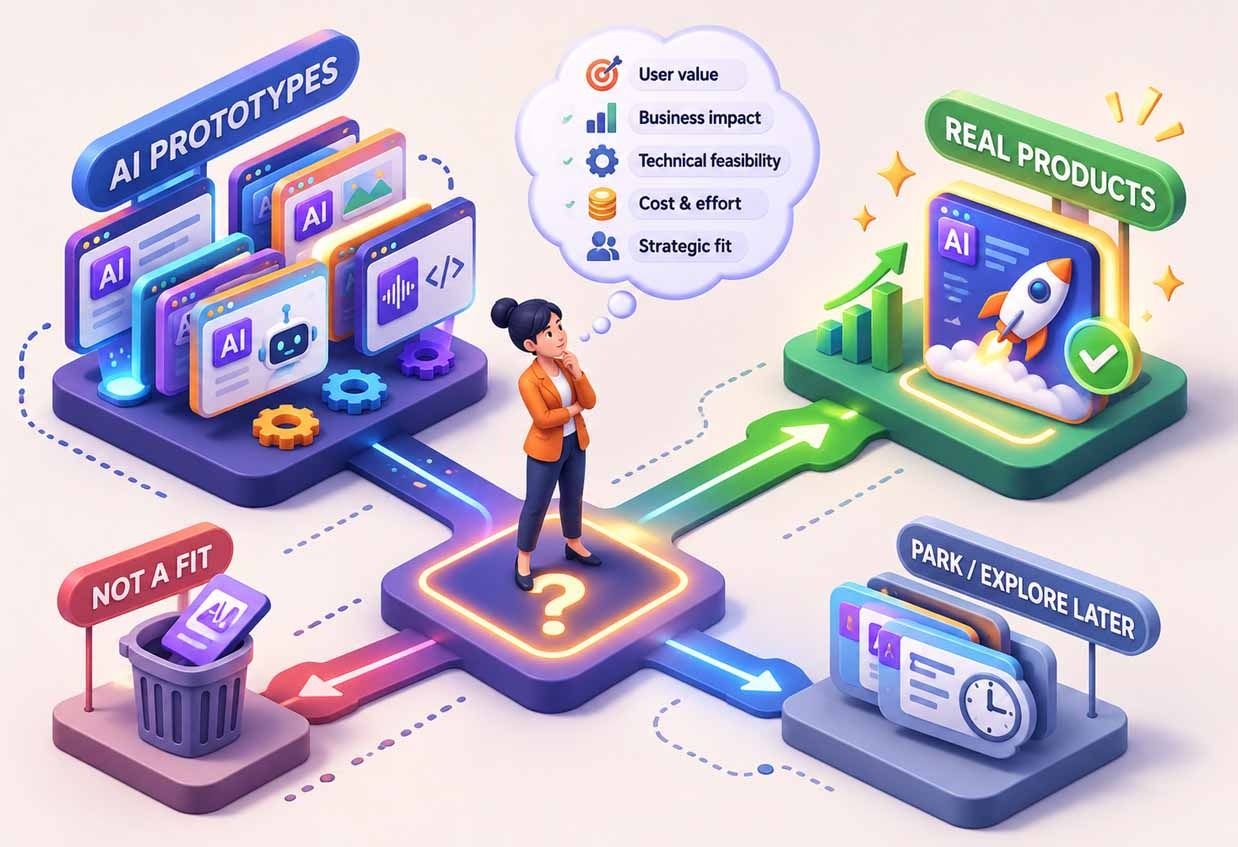
Let anyone prototype, but keep prototypes away from live customer and company data, and give each one a fixed review date. Promote a prototype only when it has a named owner, a real user who depends on it, and a known running cost. Everything else gets archived, and that’s the process working, not failing.
Why has AI made prototypes cheap, but not production?
AI coding and design tools have collapsed the cost of a first version. A working interface that used to take weeks of design and front-end work can now appear in a day. We took Cybist Online’s scope of work to a clickable prototype of a full internal operations platform, covering goods-in, production, per-unit profit and engineer performance, in one day, designed in Figma with AI.
What hasn’t got cheaper is everything a prototype leaves out: authentication, permissions, tests, error handling, backups, monitoring, data protection, and someone to call when it breaks. Those are most of the cost of software over its life. AI tools don’t remove them. They make it easier to skip them without noticing.
So the problem in most organisations isn’t too few prototypes. It’s too many, with no rule for which ones are allowed to become load-bearing.
What are the stages between a prototype and a product?
A simple way to think about it is three stages, here called Play, Prove and Promote. It’s a suggested model rather than a formal method; the point is to be explicit about what’s allowed at each stage.
Play | Prove | Promote | |
|---|---|---|---|
Who can start it | Anyone | Anyone, with a named sponsor | Agreed by the product or delivery lead |
Data | Sample, synthetic or public data only | Approved extracts; no live personal or client data | Real data, under your normal data protection controls |
Where it runs | A personal sandbox or prototype environment | A shared test environment | Production infrastructure |
Review | None | A fixed review date | Code review, testing and a security review before launch |
Owner | Whoever built it | The sponsor | A named owner responsible for running it |
Usual outcome | Archived | Promoted or stopped | Maintained, monitored and budgeted |
Most prototypes should never leave Play. That’s what Play is for. The value is in what you learn quickly, not in keeping the thing you built.
What should you ask before a prototype is promoted?
Four questions do most of the work. If any answer is “not sure”, the prototype stays where it is.
- Who uses it, and what happens to them if it disappears tomorrow? A real user with a real dependency is the strongest signal. “It would be nice to have” is not.
- What data does it touch? Personal, client or financial data raise the bar straight away, including your UK GDPR obligations.
- Who maintains it? A named person or team, with time set aside to do it. “Whoever built it” stops being an answer the day they move on.
- What does it cost to run, and what happens when it breaks? Model API usage, hosting, licences and support time, estimated per month, plus a plan for when it goes down.
For anything with AI in it, add a fifth: how will you know when the model is wrong? Production AI needs a way to check its outputs, a human review step where the stakes justify one, and logs you can investigate.
What changes when a prototype goes into production?
Promotion isn’t a deployment. It’s rebuilding the parts the prototype skipped. Typically:
- Security: proper authentication and role-based access, secrets out of the code, and scoped access to connected systems. An AI agent or MCP integration gets the permissions it needs, not an admin token.
- Data: live sources replace extracts, with validation on the way in and a retention policy.
- Testing: automated tests for the core logic and, for AI features, an evaluation set of real examples to check output quality before and after every change.
- Review: code review by someone other than the author.
- Operations: monitoring, alerting, backups and running-cost tracking.
- Ownership: documentation and a support route that doesn’t depend on one person.
The NCSC’s guidelines for secure AI system development are a useful checklist for this step.
Often the prototype’s code is thrown away and the logic is rebuilt properly. That’s normal. The prototype’s job was to find out what was worth building.
What does “done properly” look like?
Ternan Energy’s Cable Burial Risk Assessment started life as a twelve-tab Excel workbook, at the limit of what it could carry. In effect it was a prototype that had become critical. We rebuilt it as a Python calculation engine and React application on Microsoft Azure, handling vessel data at the scale it actually arrives. The first version, an MVP, was delivered in two weeks. The workbook proved the method. The rebuild made it something the business could rely on. Read the Ternan Energy case study
Cybist Online shows the earlier stage. The one-day prototype let the client see and test an operations platform before committing to a build, which is exactly what a prototype is for. See the Cybist Online prototype
How often should prototypes be reviewed?
Set the review date when the prototype is created; two weeks is a sensible default. On that date ask one question: is anyone using this, and would they mind if it vanished? If yes, it moves to Prove and gets a sponsor. If no, archive it and write down what you learned. Doing nothing should mean deletion, not drift.
FAQs
What’s the difference between an AI prototype and an MVP?
A prototype tests whether an idea is worth building, and it can cut every corner. An MVP is the smallest version that real users rely on, so it needs production basics: security, testing and an owner.
Can an AI prototype go straight into production?
Rarely safely. The logic and the design usually carry over; the code is usually rebuilt around authentication, data handling, tests and monitoring.
Should staff be allowed to build their own AI tools?
Yes, in a sandbox with no live personal or client data and a fixed review date. The risk isn’t people building things. It’s the business quietly depending on something nobody owns.
How do you stop AI prototypes becoming shadow IT?
Keep a simple register of what exists, set a review date for each item, and hold to one rule: nothing touches real data until it has been promoted.
Got a prototype that has quietly become critical?
We’ll review it: what it does, what it touches, and what it would take to run it properly, whether that’s hardening what you have or rebuilding the parts that matter. Our AI and agentic AI work starts from exactly this kind of review.