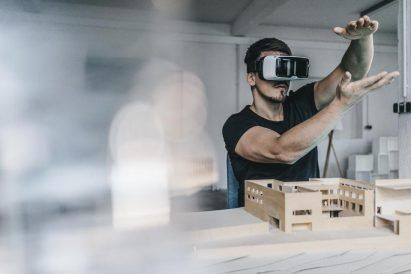
Originally published February 2021, during the lockdown VR boom. Updated September 2026 with a practical look at where immersive technology delivers business value today.
Quick answer: Is VR worth it for business in 2026?
Yes, in specific areas. Virtual and augmented reality deliver clear value for hands-on training in dangerous or expensive scenarios, for reviewing designs and spaces before they’re built, and for remote expert assistance. VR didn’t become the everyday “new normal” many predicted in 2021. For most operational problems, a mobile app using computer vision delivers value faster and at lower cost.
Key takeaways
- Immersive tech works best where practising in the real world is dangerous, costly or impossible.
- Content creation and device management, not the headsets, are usually the biggest costs.
- For field operations, the phone already in someone’s pocket is often the better tool.
- Pilot one scenario, measure it, then decide whether to scale.
What happened after the lockdown VR boom?
When we wrote this post in early 2021, people were stuck at home and VR headsets were having a moment. Once lockdowns ended, much of the consumer novelty faded. The technology kept improving, with lighter standalone headsets and mixed-reality passthrough that blends digital content with the real room, but the investment spotlight moved to AI. The businesses still getting value from immersive tech are the ones that applied it to a specific, measurable problem rather than to “the metaverse” in general.
What is the difference between VR, AR and mixed reality?
- Virtual reality (VR): a fully digital environment that replaces what you see.
- Augmented reality (AR): digital information overlaid on the real world, through a phone, tablet or smart glasses.
- Mixed reality (MR): digital objects that interact with the real environment around you, usually through a headset with cameras.
Where do VR and AR deliver business value?
Use case | Why it works | Typical sectors |
|---|---|---|
High-risk skills training | Practise dangerous or rare situations safely and repeatedly | Energy, construction, manufacturing, healthcare |
Design and spatial review | Spot problems in a space or product before it is built | Architecture, construction, factory layout |
Remote expert assistance | An expert guides an on-site worker through AR annotations, cutting travel | Field service, maintenance, utilities |
Digital twin visualisation | Explore live operational data in the context of a physical site | Manufacturing, infrastructure, property |
Product demonstrations | Show large or complex equipment without shipping it | Industrial equipment, B2B sales, trade shows |
Where does immersive tech struggle?
- Content is expensive. Building realistic scenarios takes specialist skills, and they need updating when processes change.
- Devices need managing. Charging, updates, hygiene and security for a fleet of headsets add operational overhead.
- Comfort limits sessions. Headsets suit short, focused sessions, not full working days.
- Integration is often an afterthought. Training results and observations need to flow into HR, safety and operational systems to be useful.
- Privacy and accessibility. Headset cameras and sensors capture data that needs protecting, and not everyone can use a headset comfortably.
Is computer vision a better bet for field operations?
Often, yes. Immersive tech is about showing people things. Computer vision is about understanding what a camera sees. For inspections, hazard reporting and site documentation, workers already carry a capable camera in their pocket, and AI can turn a photo into structured data in seconds.
That’s the approach we took with Fore-Site, a progressive web app that uses computer vision to auto-fill field compliance reports from images, with no headsets or special hardware required.
How do you decide whether VR or AR is right for you?
- Is the task physical or spatial? If it can be learned from a screen or a document, immersive tech adds little.
- Is real-world practice dangerous, rare or expensive? That’s where VR earns its keep.
- How many people will use it, and how often? Content costs are spread across users and repeats.
- Can you maintain the content? Outdated scenarios can teach the wrong thing.
- Does it need to connect to your systems? Plan integrations for results, records and reporting from the start.
How should you pilot immersive technology?
Pick one high-value scenario, use off-the-shelf hardware, and build a prototype before committing to a full programme. Agree the measures up front, such as time to competence, error rates, incidents or travel avoided, and compare them with your current approach. Scale only what clearly beats the alternative.
How High Digital can help
We help organisations test new technology quickly and honestly, through MVP development and applied AI and computer vision. If you’re weighing up immersive tech or a camera-based alternative, scope your project and we’ll help you find the simplest thing that works.
Frequently asked questions
What is the best business use of VR?
Training for tasks that are dangerous, rare or expensive to practise for real, such as emergency procedures or operating heavy equipment.
Is AR better than VR for field work?
Usually. Field workers need to see their real surroundings, so AR on a phone, tablet or smart glasses fits better than a fully immersive headset.
What drives the cost of VR training?
Mainly the content: designing, building and maintaining realistic scenarios. Hardware is a smaller share, though device management adds ongoing cost.
Did VR become the “new normal” after lockdown?
Not for everyday life or work. It settled into specific niches, especially training, design review and remote assistance, while investment attention shifted to AI.
What is the difference between immersive tech and computer vision?
Immersive tech shows people digital content. Computer vision lets software understand images and video, for example identifying hazards or damage in a photo and recording them automatically.