When Data Becomes Art
How We See the World: London has a new landmark, and for once it’s not another glazed tower, street installation or temporary sculpture that people take selfies with for a week and forget.
It’s a data centre.
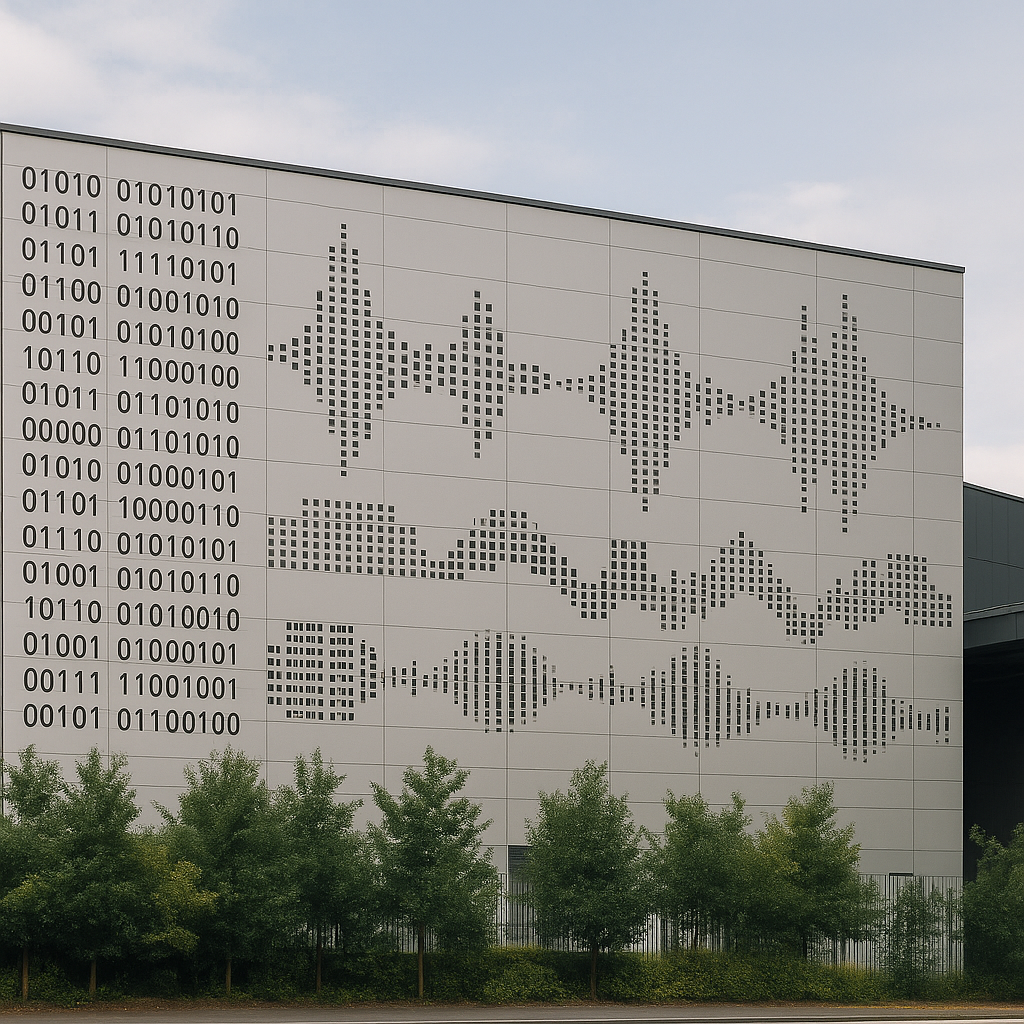
And not just any data centre — a massive, six-storey, 2,700 square metre data facility in Park Royal whose entire façade has been turned into a striking piece of public art.
Artist Rafael El Baz has wrapped the building in a visual tapestry titled 11 Million Dots, created not from paint or metal or sculpture, but from ambient sound, interviews and local voices transformed into binary code and waveforms. Over 120 recordings from residents, workers and passers-by were captured, digitised, encoded and then re-expressed as patterns across the building.
In other words:
A data centre just became literal data art.
And honestly, it’s perfect.
Because this is how we see the world anyway
At High Digital, we joke sometimes that everything eventually becomes data. Your business processes, your infrastructure, your supply chain, your audience signals, your ESG reporting, your logistics flows — all of it turns into streams, tables, objects, events. The modern world is continuously recorded, tracked, timestamped, modelled and stored somewhere. Often in buildings that look exactly like this one.
So seeing a physical data centre literally wrapped in digitised human stories feels strangely accurate. It’s a visualisation of how we view the world as data engineers, analysts and architects. Beneath every system, every process, every interaction, there’s an underlying pattern — a waveform waiting to be surfaced, translated and turned into insight.
We shape these patterns for clients every day.
This artwork makes those patterns visible to everyone else.
The poetry of turning community sound into code
El Baz didn’t choose binary by accident.
Binary is the foundation of computation.
It’s signal, structure, logic, rhythm.
It’s the smallest possible language capable of describing anything.
He collected interviews, conversations, background noise, the sonic fingerprint of a neighbourhood — then rebuilt them as sequences that stretch across the building. It’s both deeply human and entirely digital. It’s how your life becomes data before it reaches your warehouse or pipeline.
A dog barking becomes a sequence.
A delivery lorry becomes a waveform.
A local shopkeeper’s voice becomes a pattern across a façade.
It’s strangely moving, and a reminder that data, at its core, is not cold or abstract.
It’s always someone’s story.
Data centres are usually invisible. This one refuses to be.
Most data centres are intentionally anonymous.
Grey walls, no markings, no windows, no signs.
Built to disappear.
And that makes sense.
They’re secure facilities.
They’re infrastructure, not landmarks.
But they’re also the literal backbone of the digital world — quietly storing, processing and moving unimaginable flows of information every second. Your photos, your emails, your banking data, your fitness app, your CRM, your analytics platform… somewhere behind those smooth grey walls sits the hardware doing the work.
What El Baz has done is flip the script.
Instead of hiding the data centre, he’s made it expressive.
Instead of silence, there’s voice.
Instead of anonymity, there’s community.
Instead of generic infrastructure, there’s meaning.
It’s a reminder that behind every dataset, every pipeline, every workflow we build, there are people, interactions and lived experiences.
And this connects directly to the real challenges in modern data projects
At High Digital, we help organisations design, build and scale data solutions. Which sounds clean and technical. But the truth is that most data challenges are not clean. They look a lot more like this artwork:
messy, noisy, unstructured, inconsistent, endlessly human.
Talk to any analytics or data engineering team and they’ll tell you the same thing:
-
Data doesn’t arrive tidy
-
Definitions conflict
-
Context gets lost
-
Real humans introduce real inconsistency
-
Systems encode the world imperfectly
-
Meaning gets scrambled without governance
-
Stories turn into numbers, and numbers need to be turned back into stories again
That’s the real work.
Taking the noise of an organisation, a supply chain, a market or a customer base and carefully shaping it into something coherent, understandable and actionable.
This artwork visualises that transformation beautifully.
Seeing data as culture, not just computation
What’s quietly powerful about 11 Million Dots is that it breaks the illusion that data is neutral or abstract. Data is always cultural. It carries context, identity, geography, emotion, narrative. It’s the residue of human behaviour, turned into structure.
We see this in our projects:
-
ESG platforms built from emissions, travel, logistics and operational stories
-
Marketing intelligence crafted from audience patterns and real conversations
-
Analytics dashboards that reflect business realities, not just numbers
-
AI systems trained on human-labelled experience
-
Databricks or Fabric platforms built from the raw complexity of an organisation
-
Predictive models shaped by behaviour, history and unstructured signals
-
Agentic AI tools that try to interpret goals, constraints and relationships
Data is never just data.
It’s a reflection of the world.
This artwork forces us to look at it that way.
A fun reminder of why we love building data systems
We spend a lot of time thinking about pipelines, transformations, models, warehouse design, governance, agentic automation, AI-powered workflows, all the machinery.
But it’s easy to forget the bigger picture:
Data is information about people.
Data is sound, stories, movement, activity.
Data is experience transformed.
This project brings that abstraction back into the physical world.
It says something simple and brilliant:
The world is full of signals.
We just need to interpret them.
That is exactly what we do as a business.
In the end, 11 Million Dots is more than a pretty façade
It’s a metaphor for:
-
the complexity inside every dataset
-
the humanity behind every data point
-
the invisible infrastructure we rely on
-
the emerging culture around data
-
the way engineers actually see the world, as structure and story
-
and the potential of technology to express more than just logic
London doesn’t always get its public art right, but this one lands. Beautifully.
It treats data not as a byproduct of modern life, but as a creative medium.
A reminder that every pipeline, every transformation, every model leads back to something very human.
And for those of us who build data solutions, AI systems and intelligence platforms, that’s a perspective worth keeping.